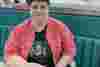
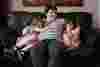
Avi Krishnan, 12 (left), has the rare inherited condition achromatopsia.
The condition causes problems in the retina, the light-sensitive tissue at the back of the eye.
It affects the specialist light-sensing cells called cones, which are responsible for reading vision and colour vision, allowing us to see fine detail and in bright light.
“I know I can't see any colour, and in general, I can't see as far away as other people can. Also, when it's very bright, it's a bit difficult to see,” said Avi.
Avi also has nystagmus, which means that his eyes ‘wobble’, which first alerted his parents, Janki and Anant, to the fact that something was wrong.
Receiving a diagnosis of achromatopsia was a shock
“Before he was one, we noticed that he wasn't pointing, nor making the appropriate sounds in terms of talking as well. Developmentally, we felt that there was something not quite right.
A health visitor referred Avi to a paediatrician, who dismissed Janki’s suggestion that this was down to vision issues.
The family disagreed, and Avi was eventually referred to Great Ormond Street, where tests revealed his achromatopsia was caused by Avi inheriting two separate “faulty” genes from each parent.
“It came as quite a shock,” said Janki, who has a degree in genetics. “We still didn’t know the implications, so we focused on practical action. But I remember doctors saying Avi wouldn’t be able to drive, and for some reason, that felt like the most shocking, horrible thing at the time.”
Seeing the world in shades of grey
“We were told he [Avi] would see in shades of grey and be very sensitive to light – he would also need things very close up to see clearly; it was very difficult to understand from our point of view.”
Asked when she notices Avi’s eye condition, Janki says it is when she’s out with him and his younger brother Aarav.
“Every time I see a rainbow, my instinct is to point it out to the children. But then I do have to check myself because, obviously, Avi can't see the colours, and I’m not sure if he sees the rainbow at all.”
Genetics and eye disease: we explain the risks and debunk the jargon surrounding genetics and the eye.

Taking part in a clinical trial for achromatopsia
Avi missed school Christmas celebrations in 2020, due to being one of nine children taking part in a gene therapy trial of his specific gene defect, where he had injections into his retina. The pioneering gene therapy trial followed a referral to Moorfields Eye Hospital, where he still has regular checkups.
The gene therapy in Avi’s left eye (his right was the “control”), included six weeks off school to reduce infection risks. After the operation to introduce a functioning gene into the retina, Avi was on steroids to prevent a negative reaction.
While the underlying problem still exists, Avi’s condition is not progressive.
Since the trial, there has been a marginal improvement in his left eye: slightly better perception and less nystagmus and light sensitivity.
“They treated one eye, and in that eye he's slightly less photophobic. So, he's less sensitive to light. His nystagmus is better. It's hasn’t gone, but it's better. He can see certain colours better. I think he can now differentiate red from black in that eye,” said Janki.
The trial was led by Michel Michaelides, Avi’s consultant who received an initial grant for his work into achromatopsia in 2010, funded by a Gift in a Will to Fight for Sight.
Meet Michel Michaelides, the researcher and clinician who, some say, has 'cured blindness'.

The importance of eye research
Janki said when the opportunity to take part in the trial arose, the family jumped at it.
“Research takes time. It takes a lot of time and money and may not work perfectly or at all, but we just felt that we couldn't miss that opportunity to try. That's what research is about. If we can help progress any kind of understanding into sight loss, that's beneficial as well.”
Avi also values research and said it is important because: “people might be able to find a treatment.” But he’s just as keen to raise awareness of achromatopsia and “more about vision loss in general.”
Fundraising for Fight for Sight
Already, he has contributed to research and awareness by fundraising for Fight for Sight. Last year, Avi, his brother Aarav and dad Anant [50] each swam 8km in 30 days, with Janki counting laps.
“He [Avi] has always loved his bath times and loves water,” said Janki.
The family exceeded their £1,000 target by over 250%, raising £2,500 for Fight for Sight.
Avi said: “I’m at the stage where I can give back. Fight for Sight’s a wonderful charity with a mission to stop sight loss through pioneering research, and we need funding to get there.”
Both boys did fundraising talks at school. Anant, a radiologist, says: “After Aarav’s speech, an older pupil told him he also had nystagmus. This is why it’s important to share stories; to reach people.”
Younger brother Aarav is, said Janki, Avi’s “right-hand man.” “He's always supported him, though Avi is fiercely independent and doesn't always want that support, thinking Aarav is his younger brother after all and shouldn’t need his help.”
Aarav remains Avi’s biggest cheerleader, adding: “The world isn’t built for people like my brother, even though he’s brilliant. Avi is funny, kind, incredibly clever and my best friend. I’m very proud of him and lucky to have him as my big brother.”
Meet the researchers conducting research into achromatopsia and other inherited eye diseases.

Adaptations for achromatopsia at school and in the classroom
At school, Avi wears tinted glasses and sits at the front of the class, with a computer to mirror the whiteboard. His Education Health and Care plan (these outline special educational needs, support and goals) includes support hours from a Qualified Teacher of Children and Young People with Vision Impairment (QTVI), occupational therapy and speech and language help.
However, his parents had to battle the local authority for this support, including having to go to a tribunal to secure appropriate support. Janki and Anant feel strongly about equal access to education for children with vision impairment, and support more special educational needs-specific training for teachers.
“We feel strongly about equal access to education for children with vision impairment, and support more special educational needs-specific training for teachers. Shifting awareness and attitudes towards sight loss is vital.”
Both agree that shifting awareness and attitudes with sight loss is vital
Optimism for the future.
For families facing similar situations, Janki says: “Trust your instincts - you know your child better than anyone. If there's something wrong, don't stop questioning. Have the same expectations you would of any other child. Nothing should stop our children from achieving what they want.”
As for Avi, he’s looking forward to Christmas, which he says, “has a certain smell.” “We used to put mince pies out for Santa. I’m excited because I wonder what gifts we are going to get.”
Related content
-
Donate Now
- Donate Now