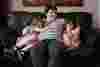
Julieanne Crothers lost vision and some of her hearing following a car accident and a related stroke. She also lives with the related condition Charles Bonnet Syndrome (CBS).
Here, she shares her experience of adjusting to vision loss as a single mother caring for her autistic child.
At 46, Julieanne was involved in a serious car accident. She suffered trauma and later learned she had experienced a stroke, which led to partial vision loss and hearing loss.
Julieanne has hemianopia, a condition caused by damage to the visual pathway that carries signals from the eyes to the brain.
Stroke is the commonest cause, followed by trauma and tumours.
Discover more about conditions such as hemianopia and Charles Bonnet Syndrome in
our A to Z of
eye conditions

What caused Julieanne’s vision loss: hemianopia following a stroke
Originally from Belfast, Julieanne was “involved in a serious crash”. A driver was being pursued by the police and smashed into her at high speed. “My life was turned completely on its head. My car went up into a spin, [and] I was thrown about like a crash test dummy.’”
How hemianopia was diagnosed after Julieanne’s accident
Julieanne’s accident happened during the Covid pandemic; after being discharged from hospital, Julieanne knew something was wrong beyond the more obvious injuries she'd sustained:
“I came home to my daughter, and I knew something wasn’t right. When I had the crash, I couldn’t see on my left-hand side.”

“I came home to my daughter, and I knew something wasn’t right. When I had the crash, I couldn’t see on my left-hand side.”
Julieanne was discharged from hospital but later visited an optician who referred her to eye casualty. Following further tests, experts confirmed she had had a stroke and that is what was responsible for the vision loss. She was referred to stroke unit:
“It felt like I was losing my independence completely. I heard the word stroke, first, and then they said ‘hemianopia’ and I didn’t know what that meant.”
Julieanne soon learned that hemianopia is the loss of vision in half the visual field, on either the right or left side, which can occur after a stroke, brain injury, or a brain disease. The condition can sometimes be treated, but as Julieanne experienced, it can have a major effect on someone’s life and independence.
“I had a daughter who was disabled with her autism. She couldn’t go out and go to the shops for me. She was still at school. I was told it wasn’t safe for me to go out on my own”.
Julieanne had a career in the film and television industry, then moved into the charitable sector. Julieanne was unable to return to work following the accident due to the trauma she had sustained.
She found herself rebuilding her life as she knew it.
Adjusting to life with hemianopia and vision loss
A turning point came when Julieanne was referred to an Eye Care Liaison Officer (ECLO), who helped her understand her condition and access support.
She received support from a sensory support team within the Belfast Trust and from the RNIB in Belfast.
Initially, Julie couldn’t have long-cane training during covid, which can be such an invaluable skill for people living with vision loss. Instead, Julie got a ‘symbol’ cane at the start and built her skills and independence from there.
You can learn more about canes and their use here.
“I started to try and do things more and [I] thought, I’m not going to let this beat me, because I had my daughter to look after.”
Living with Charles Bonnet Syndrome alongside vision loss
A further complication to Julieanne’s condition arose in the form of Charles Bonnet Syndrome (CBS). CBS is a common condition linked to vision loss and can cause visual hallucinations. Julieanne says she sees two figures — a woman in black carrying a baby and a lollipop man — who are constantly within her vision.
You can see our CEO, Keith Valentine, talking about his experiences of living with Charles Bonnet Syndrome in this video.
Taking an active role in disability rights campaigning
Julieanne is now registered as Severely Sight Impaired (SSI) and wears hearing aids.
But she has turned her experiences into action, volunteering for RNIB for four years having recently resigned to pursue other campaigns as well as being a member of the Belfast City Council Disability Advisory Committee.
She also takes an active role in disability rights campaigning and views herself as a disability activist.
Julieanne is a member of the #HalfFairUnfair campaign, which lobbies for free public transport for disabled people in Northern Ireland (Northern Ireland Is currently the only part of the UK and Ireland that does not offer free travel on public transport to those who meet eligibility criteria), and also serves on the Inclusive Mobility and Transport Advisory Committee (IMTAC).
Campaigning, she says, “gives me a sense of giving something back, value, and worth.”
Julieanne adds: “There’s those who don’t or can't speak out. If I can use my past skills and experience with my lived experience of sight loss, maybe I can make a difference and help people.”
Parenting and family life with hemianopia
Julieanne describes her relationship with her daughter as involving a degree of “role reversal”. Her daughter has completed her GCSEs and A levels with great results and has learned to drive.
“Getting into a car with s stranger was a big thing for her,” said Julieanne.
They support each other day to day.
“I still support her a lot. And she gives me a lot of support, reassurance. I’m forgetful. For example, I might ask her 20 times what day it is, and that’s to do with my stroke.”
Assistive technology plays a key role
“My Alexa’s my life. I say, Alexa, remind me in 10 minutes to turn off the air fryer or whatever. But my daughter is very good at reminding me about things, and she’ll help me with technology.”
Now 21, Julieanne’s daughter now works with animals in addition to becoming a qualified dog groomer. She is also researching veterinary nursing in the longer term.
“We call her ‘the animal whisperer,” said Julieanne with pride.