March 8 is International Women’s Day, March is also Women’s History Month. It’s the perfect reason to spotlight some of the female-led research we’re funding to Save Sight. Change Lives.
Coming together to enhance our understanding of diabetic retinopathy
Through the UK Vision Research Network (UKVRN), we’re bringing together researchers from different disciplines and institutions to explore retinal degeneration. Two female researchers who are teaming up are Dr Eleni Beli and Dr Paola Campagnolo.
They will co-supervise a doctoral training programme deepening our understanding of diabetic retinopathy.
Want to learn more about the link between Diabetes and vision? Check out our 5 FAQ's about diabetes and eye health.

The impact of early career support
Professor Mariya Moosajee has dedicated her career to vision research, deeply motivated by watching her mother go blind.
Recently, we’ve awarded her a small grant to advance our understanding of the causes of primary congenital glaucoma or glaucoma that impacts children. In the same small grant funding round, we’ve selected a project led by Dr Ana Rodriguez-Martinez studying CRB1 gene-retinopathy, which is a group of inherited retinal diseases caused by mutations in CRB1 gene (which is a gene that if altered can cause conditions like retinitis pigmentosa, lebers congenital amaurosis and cone rod dystrophy).
Understanding Leber hereditary optic neuropathy (LHON)
Professor Marcela Votruba of Cardiff University is a passionate clinician-researcher.
Her connection with her patients has motivated decades of research into the genetics of vision loss. Funded by a Fight for Sight Project Grant, her current research is advancing our understanding of Leber Hereditary Optic Neuropathy (LHON). She told us, “Patients struggle with this devastating diagnosis because sight loss is so rapid and profound”.
The next generation of cells in a dish
Professor Majlinda Lako from Newcastle University generated retinal cells in a dish in 2006; her early career focus was on the development of embryonic stem cells.
Today, she’s working on the next generation of these cells, which could provide a more accurate representation of retinal cells and enable us to better understand eye disease and, therefore, accelerate treatments.
Advancing Retinoblastoma diagnosis
Dr Amy Gerrish, a research scientist at the West Midlands Regional Genetics Laboratory, is passionate about genetics and human disease. Dr Gerrish’s driving motivation for her research is to bring cutting edge genetic testing to families affected by retinoblastoma, with the ultimate aim of improving patient care.
She is immensely hopeful about what the future holds for retinoblastoma genetic research, to achieve the next goal of better predicting how retinoblastoma will progress and how patients are likely to respond to treatment, Dr Gerrish emphasises the need for strong international collaboration, highlighting the development of the European Retinoblastoma Group providing a foundation for this.
Dr gerrish is bringing diagnosis for retinoblastoma closer than ever before through our Small Grant and Project Grants.
Detecting vision loss risk earlier in children
Dr Lola Solebo is a passionate paediatric consultant ophthalmologist at Great Ormond Street Hospital. During her ophthalmology training, she saw how research can transform lives far beyond the clinic, inspired by this and the wider impact a clinical academic career could have, she stepped away from training for three years to complete a PhD.
Today, Dr Solebo’s work focuses on improving outcomes for children at risk of blindness due to childhood eye conditions. In recent years, much of her research has focused on uveitis, a serious inflammatory disease that can damage vision if left untreated.
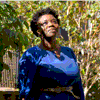
"Vision is a miracle. It's the sense we most fear losing. It's the sense we most fear our children losing."
With support from our Small Grant Award, we funded Dr Solebo’s research exploring how to predict glaucoma in children whose eyes are already affected by other conditions. Detecting this risk earlier could help clinicians intervene sooner, protecting children’s sight and improving long-term outcomes.
A recently published paper in Nature Communications co-authored by Dr. Solebo has further opened the door to potential new treatments for uveitis.
Related content


- Dr Eleni Beli and Dr Paola Campagnolo
- Professor Mariya Moosajee
- Professor Marcela Vortruba
- Professor Majlinda Lako
- Dr Amy Gerrish
- Dr Lola Solebo
-
Dr Eleni Beli and Dr Paola Campagnolo
-
Professor Mariya Moosajee
-
Professor Marcela Vortruba
-
Professor Majlinda Lako
-
Dr Amy Gerrish
-
Dr Lola Solebo
- Dr Eleni Beli and Dr Paola Campagnolo
- Professor Mariya Moosajee
- Professor Marcela Vortruba
- Professor Majlinda Lako
- Dr Amy Gerrish
- Dr Lola Solebo